P o l s k i e W i e ś c i
Showing posts with label World War II. Show all posts

Saturday, July 29, 2017

Powstanie Warszawskie: 1 sierpnia – 3 października 1944


Dziewczynka ze zdjęcie to Róża Goździewska. Sanitariuszka Różyczka pomagała w powstańczym szpitalu "Koszty" (Moniuszki 11). Przeżyłą Powstanie, zamieszkała we Francji. Zmarła w 1989 r. Mężczyzna na zdjęciu z prawej, to autor zdjęcia dziewczynki, Eugeniusz Lokajski, Jeden z najsłynniejszych fotoreporterów powstańczych (ponad 1000 zdjęć z Powstania). Przed wojną najlepszy polski oszczepnik (7 miejsce na Olimpiadzie). Zginął pod koniec Powstania, 25 września pod gruzami zbombardowanej kamienicy przy Marszałkowskiej. Ironią losu jest to, że znalazł się tam, bo chciał się zaopatrzyć w filmy do aparatu.


L: Odezwa władz powstańczych rozplakatowana na ulicach miasta 1 sierpnia 1944
P:  Biuletyn Informacyjny z 2 sierpnia 1944


Kobiety w Powstaniu Warszawskim - Fot. Eugeniusz Lokajski "Brok".
Śródmieście Północne. 
fot: Eugeniusz Lokajski "Brok" - lekkoatleta, olimpijczyk, fotograf, żołnierz
L: Dziewczyna z lusterkiem na tle zbombardowanej ulicy Złotej nieopodal Zgody
P: Bożena Grabowska "Magda" przeglądająca się w lusterku samochodu na podwórzu kamienicy przy Moniuszki 11


Powstańcza barykada na skrzyżowaniu ulic Żytniej i Karolkowej

Śródmieście Północne. Ślub sanitariuszki Alicji Treutler "Jarmuż" i plut. pchor. Bolesława Biegi "Pałąka" w kaplicy przy Moniuszki 11; młoda para po wyjściu z kaplicy na podwórze przyjmuje życzenia; za nimi stoi Bolesław Biega, ojciec pana młodego, obok w furażerce Danuta Żabińska "Amazonka"

Mieszkańcy Pragi witający wkraczające oddziały sowieckie

Sunday, March 12, 2017

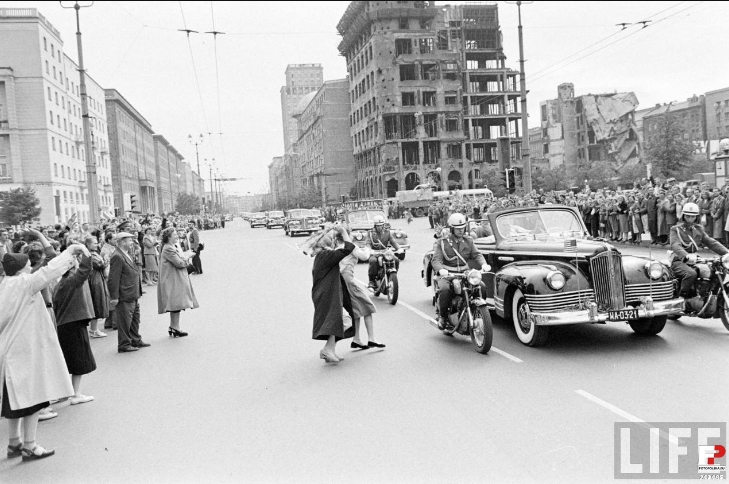
Wizyta wiceprezydenta Richarda Nixona w Warszawie (sierpień 1959)

Richard Nixon w dniach 2- 5 sierpnia 1959 roku jako pierwszy urzędujący wiceprezydent Stanów Zjednoczonych odwiedził Polskę w ramach oficjalnej wizyty i spotkał się m.in. z Władysławem Gomułką

  • Podczas swojej wizyty w Warszawie Nixon zwiedził Stare Miasto i Wilanów, złożył także wieniec pod Grobem Nieznanego Żołnierza. Tematem półtoragodzinnej rozmowy z Edwardem Gierkiem były sprawy gospodarcze — m.in. zakup licencji i przyznanie Polsce amerykańskich kredytów.


Nixon oglada pomnik Bohaterów Getta. W tle koszary.

Nixon na ulicy Zamenhofa.


Nixon przed Pałacem Myślewickim.


Wizyta w hucie "Warszawa"

Saturday, May 9, 2015

The Invasion of Poland : September 1939

On the left – Soviet officer, on the right – German officer, in the middle – German unteroffizier and probably translator. USSR and Nazi Germany worked together in conquering Eastern Europe of which this picture is testimony. This photo was taken during Soviet – German Military Parade in Brześć-nad-Bugiem, Sep. 22, 1939. Soviets and Germans met to celebrate the victory over Poland. That September, in violation of their own treaties with Poland, both of these allies invaded and partitioned the Second Polish Republic. Thus began World War II.

Soviet and German soldiers friendly conversation in the newly captured Polish city of Brest, 1939

The Soviet and German troops met on numerous occasions. The most remarkable event of this kind occurred at Brest-Litovsk on 22 September. The German 19th Panzer Corps—commanded by General Heinz Guderian — had occupied the city, which lay within the Soviet sphere of interest. When the Soviet 29th Tank Brigade—commander by S. M. Krivoshein — approached, the commanders negotiated that the German troops would withdraw and the Soviet troops would enter the city saluting each other. At Brest-Litovsk, Soviet and German commanders held a joint victory parade before German forces withdrew westward behind a new demarcation line.

The Molotov-Ribbentrop Pact on 23 August (1939) included a secret protocol that divided territories of Poland between Germany and Soviet Union. The Soviets agreed to aid Germany in the event of France or the UK going to war with Germany over Poland and, in a secret protocol of the pact, the Germans and the Soviets agreed to divide Eastern Europe, including Poland, into two spheres of influence; the western 1/3 of the country was to go to Germany and the eastern 2/3 to the Soviet Union.

According to Stalin, the joint aim of the Soviet Union and Nazi Germany was to “re-establish peace and order” in the territories of the “former Polish state”, which had been destroyed by the “collapse of the former Polish state”, and to help the Polish people establish new conditions for its political life. Needless to say, that the “collapse of the former Polish state” had been brought about by the very powers which now promised to “re-establish peace and order”.

NY Times, 17 August 1939

August 17, 1939. New York Times reports on Germany's ultimate demand to Poland that Danzig and territory in western Poland be returned to Germany. The same article affirms the nonchalance of the US & UK while strongly suggesting the inevitability of war.

Monday, February 16, 2015

Warszawa 1946


Leads to the question of who has been framing the pictures all these years? Who has been writing our history books? Who is editing the stories for TV, radio, newspapers and magazines? Why do so many want to just forget about the "ancient" history of Poland?

Sunday, January 4, 2015

World War II : Ukrainian Askaris helping the Germans during the Warsaw Ghetto Uprising, 1943

Two Ukrainian Askaris peer into a doorway past the bodies of Jews killed during the suppression of the Warsaw Ghetto Uprising. The original German caption reads: “Askaris used during the operation.”

Two Ukrainian Askaris peer into a doorway past the bodies of Jews killed during the suppression of the Warsaw Ghetto Uprising, 1943.

Askaris were Red Army deserters who formed units fighting on Eastern front. During WWII, the Germans used the term “askaris” for Red Army deserters who formed units fighting against the Red Army and in other action on the Eastern Front. They were largely Ukrainians and Russians. Askaris troops were not part of SS, were just auxiliary troops. The word askari is a loan word from Arabic meaning “soldier”, which in turn is from Persian (lascar – meaning “Army”). In the context of World War II the term often has connotations of collaborationism, and (in the case of the occupied Soviet territories) of anti-Bolshevism (and widely presented by Germans as such).

From April 19 to May 16, 1943, during World War II (1939-45), residents of the Jewish ghetto in Nazi-occupied Warsaw, Poland, staged an armed revolt against deportations to extermination camps. On April 19, 1943, the Warsaw ghetto uprising began after German troops and police entered the ghetto to deport its surviving inhabitants. Seven hundred and fifty fighters fought the heavily armed and well-trained Germans. The ghetto fighters were able to hold out for nearly a month, but on May 16, 1943, the revolt ended. The Germans had slowly crushed the resistance. Of the more than 56,000 Jews captured, about 7,000 were shot, and the remainder were deported to camps. This Uprising was the largest single revolt by Jews during World War II.

Sunday, October 31, 2010

Only 2 survivors remain from Nazi camp Treblinka

875,000 Jews were systematically murdered there in a one-year killing spree

(left: Samuel Willenberg and Kalman Teigman are believed to be the last two survivors of the most chillingly efficient killing machine of the Nazi Holocaust: the Treblinka extermination camp in Poland. The 87-year-old Israelis escaped the death trap and are now devoting their final years trying to preserve the memory of the 875,000 people who were systematically murdered at Treblinka in a one-year killing spree at the height of World War II)

They are believed to be the last two survivors of the most chillingly efficient killing machine of the Nazi Holocaust: the Treblinka extermination camp in occupied Poland.

Samuel Willenberg and Kalman Taigman, 87-year-old Israelis, are devoting their final years to trying to preserve the memory of the 875,000 people systematically murdered in a one-year killing spree at the height of World War II. Almost all of them were Jews.

Only 67 people are known to have survived the camp, fleeing in a brazen revolt shortly before Treblinka was destroyed. Following the recent death of a prominent chronicler, Israel's national Holocaust memorial says the two Israeli men are now the final living link to one of the most notorious death camps in human history.

"The world cannot forget Treblinka," said Willenberg.

"Soon there will be no one left to tell," added Taigman.

Treblinka holds a notorious place in history as perhaps the most vivid example of the "Final Solution," the Nazi plot to rid Europe of Jews.

Along with the lesser known Belzec and Sobibor camps, it was designed with the sole intention of exterminating Jews, and Treblinka was by far the deadliest. Victims, transported there in cattle cars, were gassed to death almost immediately upon arrival.

Only a select few — mostly young, strong men like Willenberg and Taigman, who were both 20 at the time— were spared an immediate trip to the gas chambers and assigned to maintenance work instead.

On Aug. 2, 1943, a group of Jews stole some weapons, set fire to the camp and headed to the woods. Hundreds fled, but most were shot and killed by Nazi troops in the surrounding mine fields or captured by Polish villagers who returned them to Treblinka.

The survivors became the only source of knowledge about Treblinka, because the Nazis all but destroyed it in a frantic bid to cover their tracks.

Willenberg said he was shot in the leg as he climbed over bodies piled at the barbed wire fence and catapulted over. He kept running, ignoring dead friends in his path. He said his blue eyes and "non-Jewish" look allowed him to survive in the countryside before arriving in Warsaw and joining the Polish underground.

Later in life, he took to sculpturing to describe his experiences. His bronze statues reflect what he saw — Jews standing on a train platform, a father removing his son's shoes before entering the gas chambers, a young girl having her head shaved, prisoners removing bodies.

"I live two lives, one is here and now and the other is what happened there," Willenberg said in an interview at his Tel Aviv apartment. "It never leaves me. It stays in my head. It goes with me always."

His two sisters were murdered there. He described his survival as "chance, sheer chance," choking back tears. "It wasn't because of God. He wasn't there. He was on vacation."

In all, the Nazis and their collaborators killed about 6 million Jews during the Holocaust. The death toll at Treblinka was second only to Auschwitz — a prison camp where more than a million people died in gas chambers or from starvation, disease and forced labor.

Taigman said he recalls the uprising vividly, and that resisting the Germans was a "dream" for the prisoners.

He entered Treblinka holding the hand of his mother, who was quickly pulled away from him and murdered. He left watching a Nazi flag burning in the distance from a blaze they had set — a small piece of revenge after nearly a year of torment.

"It was hell, absolutely hell," said Taigman, who lives in a retirement home south of Tel Aviv. "A normal man cannot imagine how a living person could have lived through it — killers, natural-born killers, who without a trace of remorse just murdered every little thing."

Taigman, who wandered in the Polish countryside for nearly a year after his escape, said his most lasting memory of Treblinka is fellow prisoners who had to remove bodies — often their own relatives — from gas chambers.

Treblinka holds such a powerful grip on the Jewish psyche that the will of a recently deceased Holocaust survivor in Israel instructed her children to cremate her body and sprinkle her ashes at the Polish memorial site — so that she could finally be reunited with her relatives who perished there.

After the war, Willenberg and Taigman made their ways to Israel, where they pursued careers and raised families. Willenberg became a surveyor in Israel's Housing Ministry, while Taigman was an importer. The survivors have maintained their special connection, meeting each other often over the years.

David Silberklang, a senior historian at Israel's Yad Vashem Holocaust memorial, said that in contrast to other camps where Jews were also used for industrial labor, Treblinka truly represented the essence of the Nazi Final Solution.

"Treblinka had nothing, just killing, and they almost finished the job. These camps left us almost nothing," he said.

Without the survivors, he said "it would just be a black hole, we would know nothing. With them, we know quite a lot," he said.

One of the men most responsible for documenting the atrocities was Eliahu Rosenberg, who was tasked with removing bodies from gas chambers and dumping them into giant pits. He passed away in September, but before his death recounted his experiences in a video testimony to Yad Vashem.

"It poisoned, choked people within 25 minutes, all would suffocate. It was terrible to hear the screaming of the women and the children. They cried: "Mama!" "Tata! (Dad)" but in a few minutes they choked to death," he said.

"The crematoriums were train rails which lay on a concrete base. On them were wood planks, we called it 'grills.' We threw the body parts onto those 'grills,' and with a match everything burnt. And we stood there ... and it burned all night, all night long."

After the revolt, the Nazis attempted to destroy all evidence of their atrocities. The camp structures were destroyed, the ground plowed and planted over. Today, all the remains at the site are a series of concrete slabs representing the train tracks, and mounds of gravel with a memorial of stone tablets representing lost communities.

The two remaining survivors have returned to lead tours of the site. Taigman made the trip just one time, saying it was too painful to go back again, while Willenberg has gone on several occasions, most recently last week.

"There are only two of us left. After we go, there will be nothing," said Willenberg. "All I will leave behind are my sculptures and most importantly, my daughter and my grandchildren."